Showing posts with label mesa verde. Show all posts

Sunday, March 3, 2013

Pots and baskets and jewelry, oh my!

Our last stop in Mesa Verde was the visitors center across the road from the Far View Terrace dining hall and gift shop. It serves as both a mini museum and gift shop, and visitors can purchase tickets for the guided tours of the cliff dwellings there. The museum portion features exhibits of "modern" Native American pottery, baskets, and jewelry, and by modern, I mean only as compared to the antiquities in the Chapin Mesa Archaeological Museum. Most of the artifacts in this collection date from the late 1800s and early 1900s, and they encompass some of the finest pieces of Native art I've ever had the pleasure to see.

I'll start with the pottery. The most easily recognizable Puebloan pottery, even for non-potheads, is the famous San Ildefonso black-on-black ware made by Maria Martinez and her family. Two of these pieces show her distinctive feathered pattern, and I am especially enamored of the avanyu plate on the right. These pieces were made in 1970.

The following pots probably all date between about 1880-1930, and because pots from that time were generally made to be used rather than made to be sold to collectors and tourists, they are exceedingly rare. These pieces are all hand-coiled, hand-decorated, and pit-fired.

Circa 1880s Zuni olla

Circa early 1900s Acoma olla

Circa 1930s Cochiti olla

Several early Hopi pieces
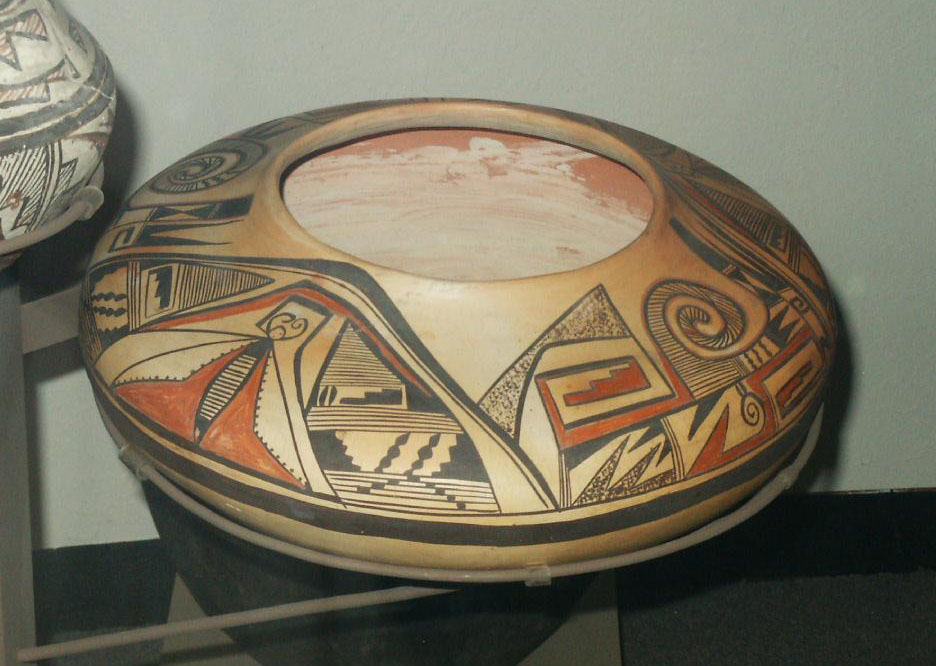
 More Acoma pieces

 A group shot to give you a sense of scale. Pots the size of the big Cochiti piece at the bottom center are extremely rare and unusual. On the right-hand post, from top to bottom, the pots are Acoma, Zuni, Hopi, Hopi, very old Cochiti, and Hopi. On the left-hand post, the pots are Acoma (obscured by glare), Acoma, Hopi, probably Cochiti, and Santa Clara.

Moving on to woven vessels, these baskets are Apache.

Exquisite, tiny baskets by the Pima tribe (now more properly called the Akimel O'odham). As the name suggests, they are descendants of the ancient Hohokam people.

And the jewelry! Some Zuni inlay.

Navajo silversmithing

Santo Domingo bow guards. These are decorative versions of the gear used to protect your inner arm from string-snap.

More Santo Domingo shell-work

Navajo and Zuni fetish and heishi necklaces

 Silver from the Isleta and Laguna pueblos

 By the time we finished admiring the incredible art in the visitors center, it was late afternoon and time for us to hit the road to Cortez. Some parting shots of the road out of Mesa Verde.

 Back on the highway  and headed west to Cortez, CO.

Our hotel (Holiday Inn Express) had neat petroglyph tiles in the lobby...

And this incredible Navajo sand painting was hanging nearby.

We were also excited to find that Navajo silversmith Freida Lansing had a table set up in the lobby where she was selling her lovely jewelry and her husband Jess' intricately carved pottery. (You can follow Frieda on Facebook here.) I have long admired Navajo jewelry, and until I met Freida, I only had a few small pieces that had been found in garage sales or antique stores. Seeing the collection of jewelry at Mesa Verde and Freida's table full of fabulous turquoise was my first real exposure to the variety of styles used by Navajo artists. I was interested in learning more (and acquiring more), and I was happy to find a piece by Freida to take home with me.

Next time, trading posts, a galloping goose, and Bridal Veil Falls.

Saturday, March 2, 2013

In the Footsteps of the Anasazi

Spruce Tree House, so named for a large tree growing in front of the ruins when they were first discovered in 1888, is the third largest of the cliff dwellings at Mesa Verde. The head of the 1/2 mile trail down to STH is conveniently located right next to the museum, so after perusing said museum for a couple of hours, I was anxious to see the ruins up close. My sister and I set off down the trail with cameras in hand.

View of Spruce Tree House from the lookout point above the trail

Looking back up at the lookout point (and my dad) from a little ways down the trail

It was a bright, sunny day, and I took a bunch of overexposed photos of cacti and flowers that I won't subject you to. (Suffice it to say though, there are lots of neat cacti in Colorado.) The trail descends about 100 vertical feet down into the canyon, and the last few switchbacks were shady. Even though it was in the 90s in the sun, it was quite pleasantly cool under the rim of the canyon once we reached Spruce Tree House.

Manos and metates for grinding corn

 A kiva (sans roof)

Inside a restored kiva
 
Spruce Tree House is the start of the Petroglyph Trail, a 2.5 mile loop that ends up back at the STH lookout point. My sister and I thought we could make the hike in an hour or so since it was short trail, but we didn't factor in the incredible scenery that we had to stop and photograph quite often nor the rather challenging terrain of the trail itself. 

Down the stairs...

Photo op stop

A narrow passage

Coming out the other side

Looking down a steep, narrow flight of stairs

After about 45 minutes, we realized we didn't have enough time to walk the whole trail and see Cliff Palace if we were going to get into Cortez that night in time for dinner, so we turned back. (We also hadn't brought any water...) Unfortunately, we didn't get to see any petroglyphs, but the part of the trail we did hike was hugely fun, and I can't wait to go back and see the whole thing someday soon.

After hiking back to Spruce Tree House and then back up to the rim of the canyon, we were very grateful for the water fountain by the museum. (Lesson learned.) We then drove over to Cliff Palace, the largest and most famous of the cliff dwellings at Mesa Verde. We didn't have tickets to make the climb down for the guided tour, but there's an excellent vantage point above the ruins.

Looking south down Cliff Canyon with the green tables that give Mesa Verde its name on either side

Noted archaeologist Richard Woodbury once wrote that "everyone's first visit to the southwestern United States is an occasion for enthusiasm, often for love at first sight and lifelong infatuation." Truer words have never been written. A few short days meandering through Colorado and New Mexico had me utterly and completely enthralled. If my family had made this trip while I was still in high school, I suspect that southwestern archaeology would have been my college major rather than Classical history.